Set this page to:
Go to FERI in:


T +352 270448-0
F +352 270448-729
info@feri.lu
18, Boulevard de la Foire
L-1528
Luxembourg
CONTACT
CONTACT
 Login
Login
 Languages

China has evolved from a profitable sales market to a fierce competitor—with massive overcapacity, price dumping, and record trade surpluses. For Europe and Germany, this means that key industries are coming under pressure, sales markets are collapsing, and there is a threat of creeping deindustrialization.
Until recently, China was primarily one thing for many European companies: a huge sales market with high profit opportunities. However, this picture has changed radically since 2020. While Western countries were in “corona lockdown,” China purposefully invested in new technologies and high-quality industries and massively expanded its production capacities.
Market dominance in key industries
Today, China dominates many economic sectors in which Germany previously held a strong position—including, in particular, the global automotive market (e.g., electric cars).
Overcapacity and price pressure
This development is accompanied by considerable overcapacity, government subsidies, and often targeted price dumping on the part of China.
Record trade surpluses
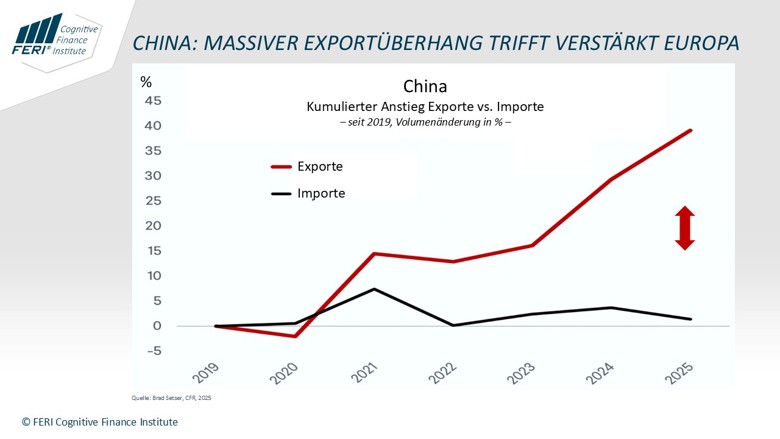
China has been recording enormous trade surpluses for around five years: exports have risen sharply since then, while imports have virtually stagnated (see chart).
Sales markets are disappearing
China is also becoming the dominant competitor for higher-value products and taking over entire market segments – with good quality at low prices.
Industry under pressure
Key German industries such as mechanical engineering, chemicals, and automobiles are losing competitiveness at a rapid pace – there is a threat of creeping deindustrialization.
Massive imbalances
The chart shows the core of the problem – China is continuously expanding its enormous trade surpluses, while countries such as Germany are losing prosperity.
Europe is currently experiencing the “second wave” of Chinese trade policy. Following the initial “China shock” in the US, this wave is now targeting mature industrialized countries such as Germany. This is one of the reasons why the German economy has seen virtually no growth for six years!