Set this page to:
Go to FERI in:


T +352 270448-0
F +352 270448-729
info@feri.lu
18, Boulevard de la Foire
L-1528
Luxembourg
CONTACT
CONTACT
 Login
Login
 Languages

Recent data show significant declines in shipping traffic through the Strait of Hormuz and Bab el-Mandab. This marks the first time that two key choke points of the global economy have come under pressure simultaneously. The current developments confirm key findings from the FERI Cognitive Finance Institute dating back to 2025—detailed in the analysis “Global Choke Points”.
The greatest risks to the global energy supply stem from a few strategic bottlenecks and “choke points”. Among the most important of these are the Strait of Hormuz and the Bab el-Mandab Strait at the entrance to the Red Sea. It is precisely there that the ongoing conflict with Iran is causing serious disruptions to global trade and the global economy.
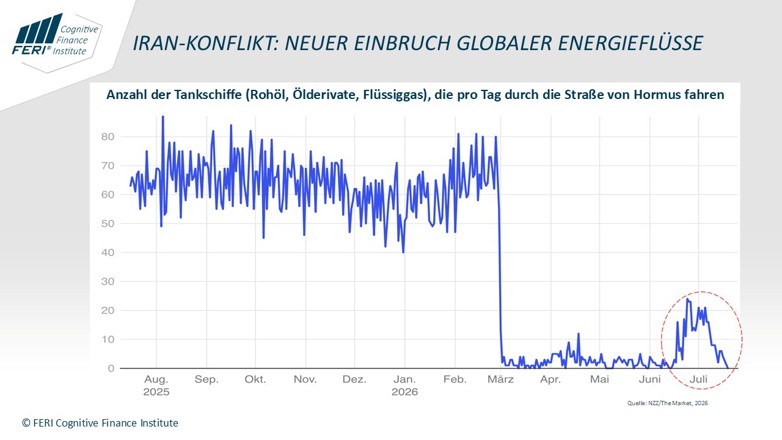
After only a brief uptick, the number of energy tankers passing through the Strait of Hormuz has once again plummeted (see chart). As a result, one of the world’s most important energy arteries remains largely cut off. At the same time, the important alternative route at Bab el-Mandab is now also coming under increasing pressure—due to targeted attacks by Houthi rebels against Saudi oil tankers and infrastructure. This dual restriction on global oil shipments—at their most critical chokepoints—poses a threat to energy prices and the global economy for the foreseeable future.
The FERI Cognitive Finance Institute clearly highlighted this vulnerability as early as 2025 in its analysis “Global Choke Points”—with a clear focus on the critical bottlenecks in the Gulf region. Today, the predictive power of this analysis is undeniable:
Maritime “choke points” determine actual energy and trade flows—and are becoming asymmetric weapons in geopolitical conflicts.
What long seemed like an abstract risk scenario is now a reality—clearly evident in the daily ship movements through critical maritime chokepoints. This development is extremely significant, as approximately 20% of global oil shipments pass through the Strait of Hormuz. Bab el-Mandab, in turn, controls access to the Red Sea and the Suez Canal—and is currently emerging as a new bottleneck for critical energy and trade flows.
Detailed information on the background of these disruptions—and their consequences for global trade and the global economy—is provided in the Cognitive Briefing “Global Choke Points", which is available in German for download on this page.