Set this page to:
Go to FERI in:


T +352 270448-0
F +352 270448-729
info@feri.lu
18, Boulevard de la Foire
L-1528
Luxembourg
CONTACT
CONTACT
 Login
Login
 Languages

China is significantly expanding its export power, while Germany’s exports are noticeably losing ground. Behind this trend lies a structural shift in global competition. Germany is thus facing the second wave of the China shock.
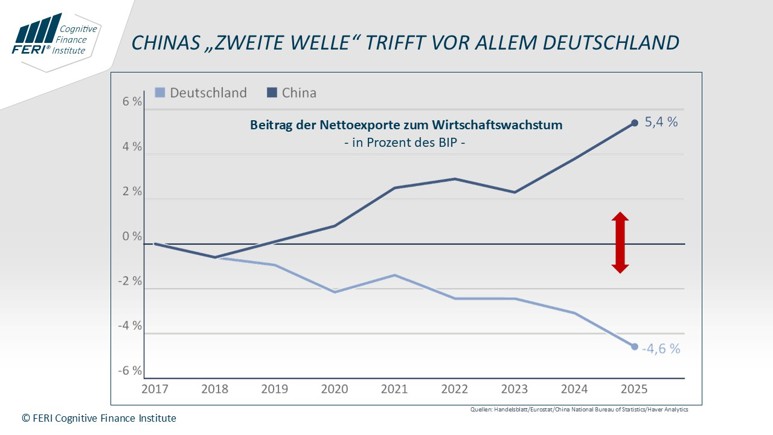
The latest data reveal a clear shift in global trade: While China’s exports are set to increase by 5.4% of GDP between 2017 and 2025, Germany’s exports are expected to decline by 4.6%. This contrasting trend is no coincidence, but rather a reflection of a radical structural transformation.
China has undergone a fundamental transformation in recent years—from a lucrative sales market to a fierce competitor. As part of the government’s “Made in China 2025” plan, key industries with high value-added have been systematically developed—precisely where German companies have traditionally been active. At the same time, China is using aggressive price competition to ensure that established players on the global market are coming under increasing pressure.
This dynamic can be described as the second wave of the China shock. Unlike the first phase, which primarily affected labor-intensive sectors in the U.S., the current trend is specifically targeting high-value-added industrial production. China is now increasingly penetrating higher-value market segments—and is steadily gaining a competitive edge there.
This has far-reaching consequences for Germany. Key industries such as automotive, mechanical engineering, and chemicals are facing growing competition, while important sales markets are gradually eroding and being taken over by Chinese suppliers. The intensified competitive pressure is also increasingly being felt in the European single market.
This makes it clear: this is not a temporary phase of weakness, but a structural challenge for export-driven business models. In a world where China is rising to become the dominant export nation, Germany faces the task of realigning its industrial competitiveness. The clock is ticking, yet neither German policymakers nor the EU have come up with a convincing response so far. The second wave continues—and a third wave is already on the horizon.