Set this page to:
Go to FERI in:


T +352 270448-0
F +352 270448-729
info@feri.lu
18, Boulevard de la Foire
L-1528
Luxembourg
CONTACT
CONTACT
 Login
Login
 Languages

In addition to being a traditional energy chokepoint, the Strait of Hormuz is also a key hub for digital infrastructure. Consequently, undersea cables for data networks are now becoming a focal point of geopolitical conflicts.
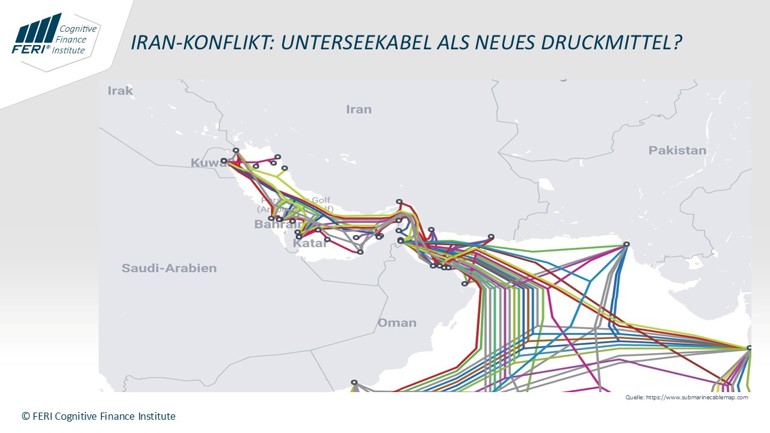
The Strait of Hormuz has long since ceased to be merely an oil chokepoint. For years, the region has served as a critical hub for global infrastructure—including in the digital realm (see chart).
This is because the Persian Gulf is home not only to key energy routes but also to vital undersea cables that carry a significant portion of international data traffic. Underestimated worldwide, these cables form the indispensable backbone of global communication, the cloud economy, and international data and financial flows.
The current developments are particularly explosive in a geopolitical context:
Iran is currently attempting to exploit this digital vulnerability—practically on its doorstep—as a strategic lever. Among other things, regulatory interventions such as fees, licensing requirements, and greater control over the maintenance and repair of undersea cables are being discussed.
The FERI Cognitive Finance Institute warns:
A new type of strategic vulnerability is thus taking shape in the Persian Gulf—
a double choke point for vital energy and data flows!
Today, critical bottlenecks are no longer merely geographical chokepoints for raw materials and goods, but are increasingly becoming hubs of digital interdependencies. The key factor is the overlap of multiple systems: energy, data, logistics, and financial flows are increasingly passing through a small number of regionally concentrated bottlenecks.
The FERI Cognitive Finance Institute warns:
Choke points thus become strategic targets where economic and political influence directly overlap and converge.
The Strait of Hormuz is a prime example of this trend: it is no longer just a critical bottleneck for energy—but increasingly also for digital networks and global data flows.
As early as 2025, the FERI Cognitive Finance Institute anticipated looming risks of escalation in the Strait of Hormuz—in the German Cognitive Briefing „Global Choke Points – Maritime Engpässe als unterschätzter Risikofaktor für Weltwirtschaft und Geopolitik“. The analysis is available in German for download on this page.