Set this page to:
Go to FERI in:


T +352 270448-0
F +352 270448-729
info@feri.lu
18, Boulevard de la Foire
L-1528
Luxembourg
CONTACT
CONTACT
 Login
Login
 Languages

The military conflict in the Persian Gulf remains unpredictable for the time being. China in particular is likely to counteract any serious disruption to oil supplies. Nevertheless, the risks to important trade routes and maritime choke points are increasing once again.
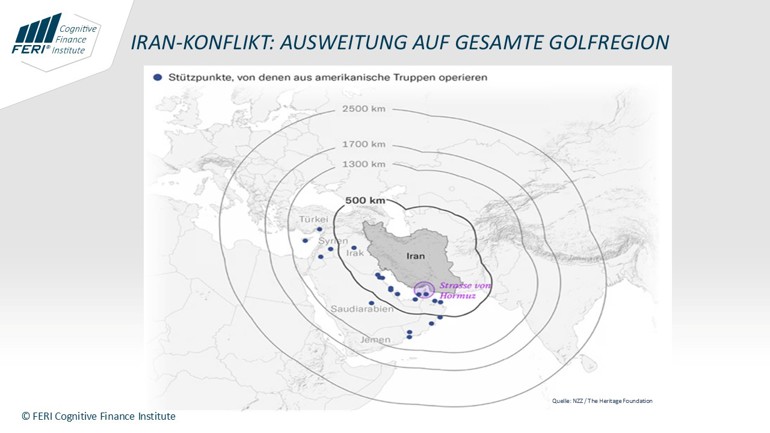
Iran is once again the target of massive air strikes by Israel and the US. This attack is putting the mullah state under existential pressure and provoking Iranian missile and drone attacks in response. These are primarily directed against Israel, but also target other countries. This is because many US military bases are located on the Arabian Peninsula and in the Persian Gulf (see graphic).
Further escalation poses serious risks: Iran could block the Strait of Hormuz for a longer period, as it has already threatened to do. The Suez Canal would also be at risk from attacks by the Houthi militias controlled by Iran. Both scenarios would mean significant restrictions on global shipping and severe disruptions to global supply chains.
Around 20% of the world's supply of crude oil and liquefied petroleum gas passes through the Strait of Hormuz. However, the majority of this (~80%) goes to Asia, with China as the most important consumer country. China's interests carry great weight in the Gulf region, which makes a prolonged oil crisis in the Persian Gulf rather unlikely.
The conflict in the Middle East has the potential to escalate sharply for the time being. Nevertheless, global oil supplies do not appear to be at risk in the long term. However, temporary disruptions to global supply chains are highly likely – including around the Suez Canal, which is an important choke point.
The FERI Cognitive Finance Institute has repeatedly warned of the underestimated risks of maritime bottlenecks – most recently in 2025 in its detailed analysis „Global Choke Points: Maritime Engpässe als unterschätzter Risikofaktor für Weltwirtschaft und Geopolitik“, which can be downloaded in German from the download area on this page.